November 27, 2026
Managed Business Travel: How It Works and Who Needs It
Managed business travel explained: what it covers, how a trip moves from request to expense report, and how a dedicated concierge fits small teams and executives.
We use measurement cookies (Google) to know which ads bring us travellers. You can accept or refuse. Learn more
November 27, 2026
Managed business travel explained: what it covers, how a trip moves from request to expense report, and how a dedicated concierge fits small teams and executives.

Managed business travel means a company routes its trips through one set of rules, one booking channel and one point of support, instead of letting each employee book alone. For an executive, an assistant or a small company without a travel department, the simplest version is a dedicated person who searches fares, books, and answers when plans change. That is how we work at Air Avenue: a dedicated concierge on WhatsApp handles your Business and First Class flights, hotels and employee bookings from quote to ticket.
AiravenueSimplify Business Travel PlanningAir Avenue’s dedicated concierge handles Business and First Class flights, hotel stays and employee bookings through WhatsApp.VisitThe Global Business Travel Association (GBTA), the industry’s main professional body, describes managed travel as business travel in organizations that look after traveler safety and well-being (their “duty of care”), control costs within budgets, run a travel policy overseen by a travel manager, and contract preferred suppliers. The source is its U.S. policy priorities report.
The opposite is unmanaged travel: employees pick their own flights and hotels on whatever site they like, then file an expense report. Nobody sees the total spend, nobody knows exactly where travelers are, and no supplier gives the company a negotiated rate.
Two terms you will meet often:
Business Travel News’ 2022 handbook lists the fundamentals of a managed program: a formal policy, support from a travel management company (TMC, the agency that books and services corporate trips), internal staff, supplier agreements, data before and after trips, an online booking tool, traveler education, and a payment and expense process.
In plain terms, that breaks into five jobs:
The GBTA Foundation’s 2011 benchmarking study found that 72% of travel managers required bookings through a single designated TMC. It describes that consolidation as the cornerstone of managed travel, because it allows compliance tracking, recovery of unused tickets and locating travelers in an emergency.
SAP Concur describes the typical workflow as request, approval, booking, itinerary preparation, the trip itself with expenses recorded, then expense submission and review afterward. Here is what each stage takes and where it usually goes wrong.
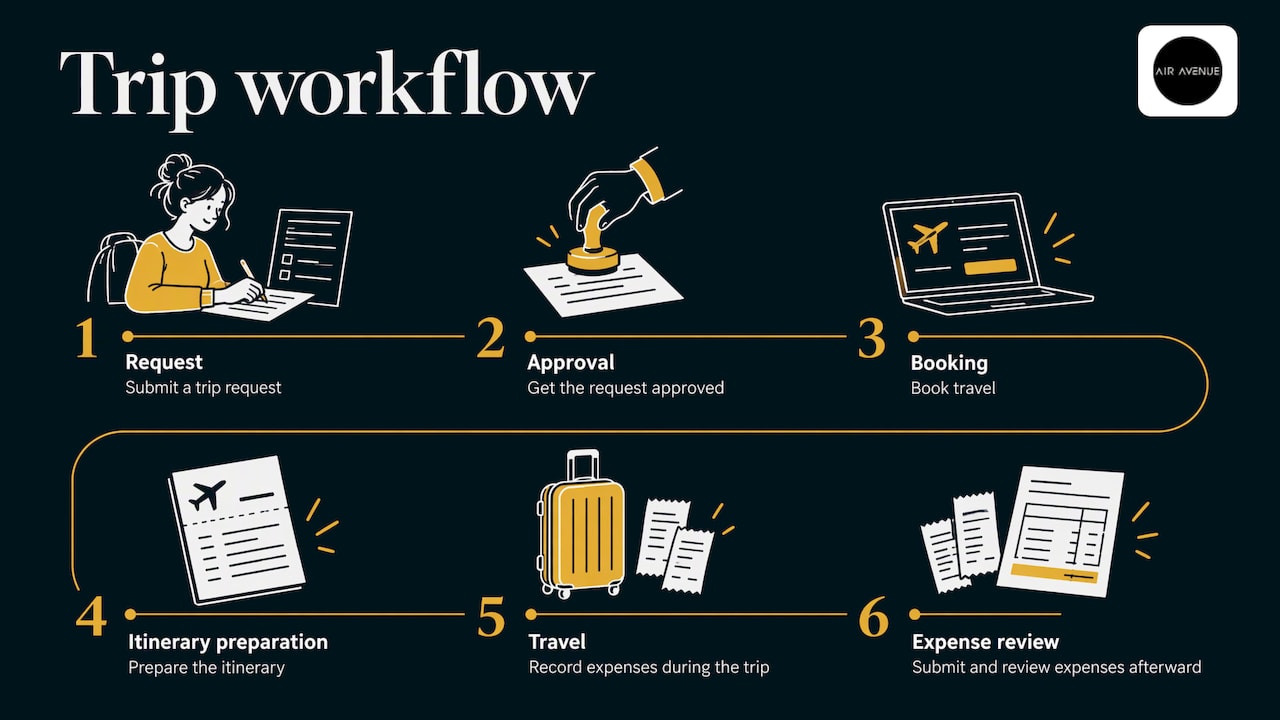
The traveler states the purpose, dates and route. An approver, often a manager or an executive assistant, checks it against policy. This stage fails when approval takes days and the fare rises in the meantime. A short, clear request (dates, flexibility, cabin, budget) shortens it.
This is where most of the money is decided. Fares for the same flight vary by fare class, timing and channel. At Air Avenue, a dedicated concierge searches airline options in real time and handles the booking from quote through ticket issuance. You approve the quote, and the ticket is issued after that.
Flights, hotel confirmations, transfers and visa or entry reminders need to sit in one place. Scattered confirmation emails are the usual failure. On WhatsApp, everything stays in a single conversation with your concierge, with no sign-up required.
This is where managed travel earns its name. Delays, missed connections and room problems need a human who already knows the booking. BTN’s 2019 report on smaller companies quotes a consultant describing disruption assistance as a potential employee-retention benefit.
Receipts, invoices and the final cost per trip. Clean records here make the next quote sharper, because you can see what the last trip really cost.
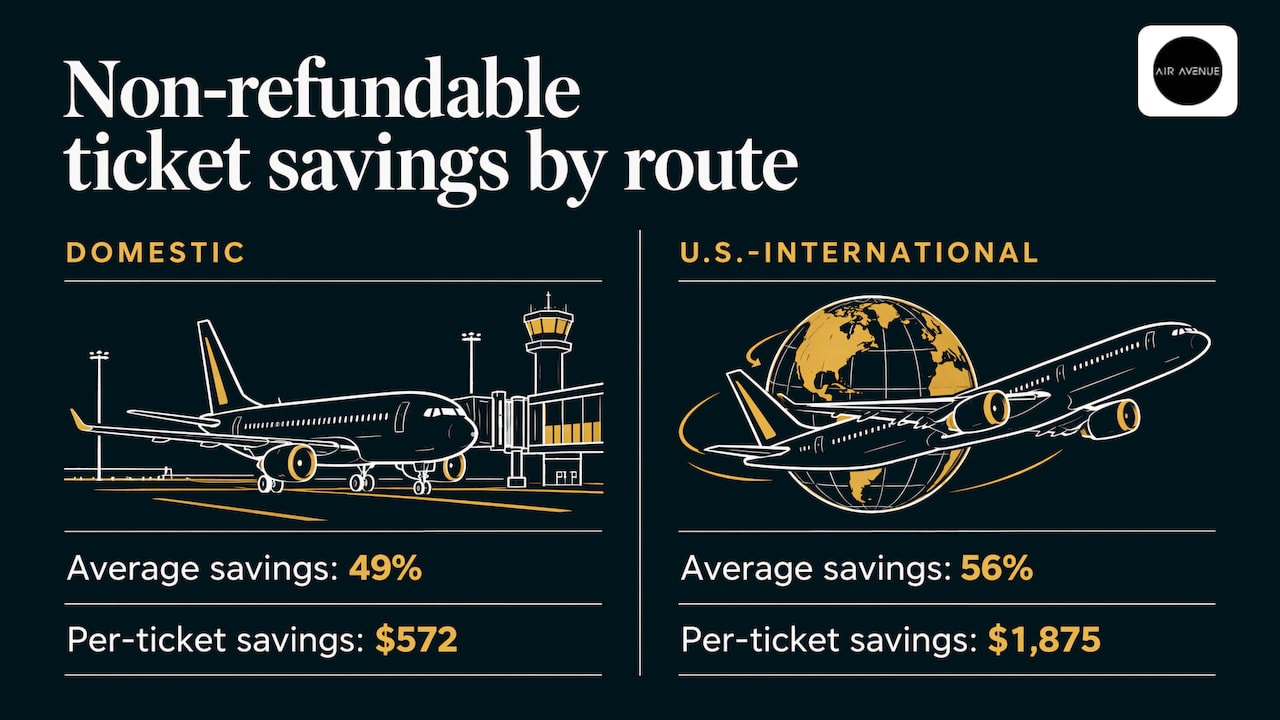
Policy is not paperwork for its own sake. The 2011 GBTA Foundation study measured it on U.S. routes: buying non-refundable tickets alone saved an average of 49% ($572 per ticket) on domestic routes and 56% ($1,875 per ticket) on routes between the U.S. and international gateways, with advance purchase windows adding more. These are 2011 figures for U.S. routes, so treat them as a measure of how much the rules matter, not as a quote for your next trip.
A worked example: a company flies one executive from New York to Europe four times a year. If the habit is last-minute, fully flexible tickets, the policy question is which trips can be planned early and which truly cannot. Fixing only the plannable ones changes the annual total, and it takes a rule, not new software.
BTN’s 2018 handbook describes five program models, from mandated controls to open booking. Tighter models improve control, data and purchasing leverage. Open booking gives travelers more choice. A good program balances cost with comfort, convenience, productivity and safety. That balance matters most for senior travelers on long-haul routes, where a Business or First Class seat is part of arriving ready to work.
A common belief is that you need to spend $1 million a year on air travel before a TMC is worth it. BTN’s 2019 report traces that figure to expectations about airline discounts and returns on management effort, and the experts it interviewed said companies need not wait for that scale. One consultant there put the start of interest around $500,000 in air spend, while an executive from a hotel group said any company with frequent travelers should adopt some components.
Small firms already do this. A BTN survey of 151 small and midsize companies, published in July 2023, found more than seven in ten closely managed travel and 16% managed it lightly.
In practice, managed travel fits:
The same BTN report says a single spend threshold is not decisive. Look at these factors instead:
| Question | Why it matters |
|---|---|
| Who travels, how often, where? | Frequent international trips benefit most from central booking |
| Domestic or international? | Long-haul routes have bigger fare gaps and more disruption risk |
| Who administers the program? | Someone must own policy and approvals |
| What support is needed? | Last-minute changes call for a reachable person |
| How are expenses handled? | Connected records save manual work |
BTN’s 2022 handbook advises aligning policy with company goals and culture and asking both frequent and occasional travelers what they need. SAP Concur’s guide adds that policy should start from today’s travel patterns rather than trying to predict every scenario. A short policy that people follow beats a long one they work around.
Full programs combine a policy, a booking tool, a TMC and an administrator. Many companies, especially smaller ones and executive offices, need the outcome without the machinery: premium fares found quickly, bookings handled correctly, and a person to call when something changes.
That is the gap a travel concierge fills. Practical advantages for a busy traveler or assistant:
The routes matter as much as the service. If you fly long-haul often, our pages on Singapore Airlines Business Class and Suites and ANA First Class and Business Class show what the seats and lounges are like, and our Geneva to Dubai Business and First Class page shows how a specific route is presented.
You can start in a week:
We arrange Business and First Class flights worldwide, hotel stays at discounted prices, and employee bookings for companies. A dedicated concierge answers on WhatsApp and handles the booking from quote to ticket, so you or your assistant send one message instead of running the search yourselves. Start at Air Avenue.
For a company, the first step is simple: send your next trip request, including dates, route and who is traveling, and your concierge takes it from there.
In managed travel, bookings follow a company policy, go through approved channels and are overseen by a responsible person. In unmanaged travel, employees book independently and the company sees the costs only afterward. Managed travel gives better control, data and support for travelers.
No. BTN’s 2019 report found experts saying companies need not reach a fixed spending level, and that any company with frequent travelers can adopt parts of a program. Trip frequency, international routes and the support you need matter more than size.
It covers the request and approval, the booking, the itinerary, support during the trip when plans change, and the expense review afterward. A concierge can take on the search, booking and ticketing steps and stay available during the trip.
Yes, and it is where a reachable person helps most. With a dedicated concierge on WhatsApp, you send the route and dates and receive real-time options, with no account to create first.
Yes. The same concierge arranges Business and First Class flights and hotel stays for couples and families, so one contact can handle both your work trips and your vacations.
Travel blog

November 7, 2026
Time saved, better prices, tailored advice: what a travel concierge really brings when booking Business or First Class flights.
Read the article
November 7, 2026
People assume a last-minute Business ticket costs a fortune. Not always: here's how to find up to 70% off at the last minute.
Read the article
November 7, 2026
Seat, dining, lounge, privacy, price: a clear comparison between Business and First Class to choose the cabin that suits you.
Read the article